Treatment · Paediatric dentistry
Paediatric dentistry in Mérignac
Child-friendly care, with conscious sedation if needed.

- Dentistdedicated to children
- MEOPAconscious sedation if needed
- Homechild-friendly, with waiting-room games
- Fromthe very first tooth
Understanding the treatment
What is the difference between a dentist and a children’s dentist?
A children’s dentist undertakes specific training over several years and works exclusively with children, from infancy through adolescence. Their work includes prevention, early detection and treatment of decay. They aim to build trust and create positive experiences that can support good attitudes to dental care into adulthood.
A first dental visit is recommended around age two, when a child has between 16 and 20 teeth, to assess tooth health and decay risk. Depending on that assessment, one or two visits a year may be planned. Early detection makes problems easier to treat and can avoid extensive, costly care.
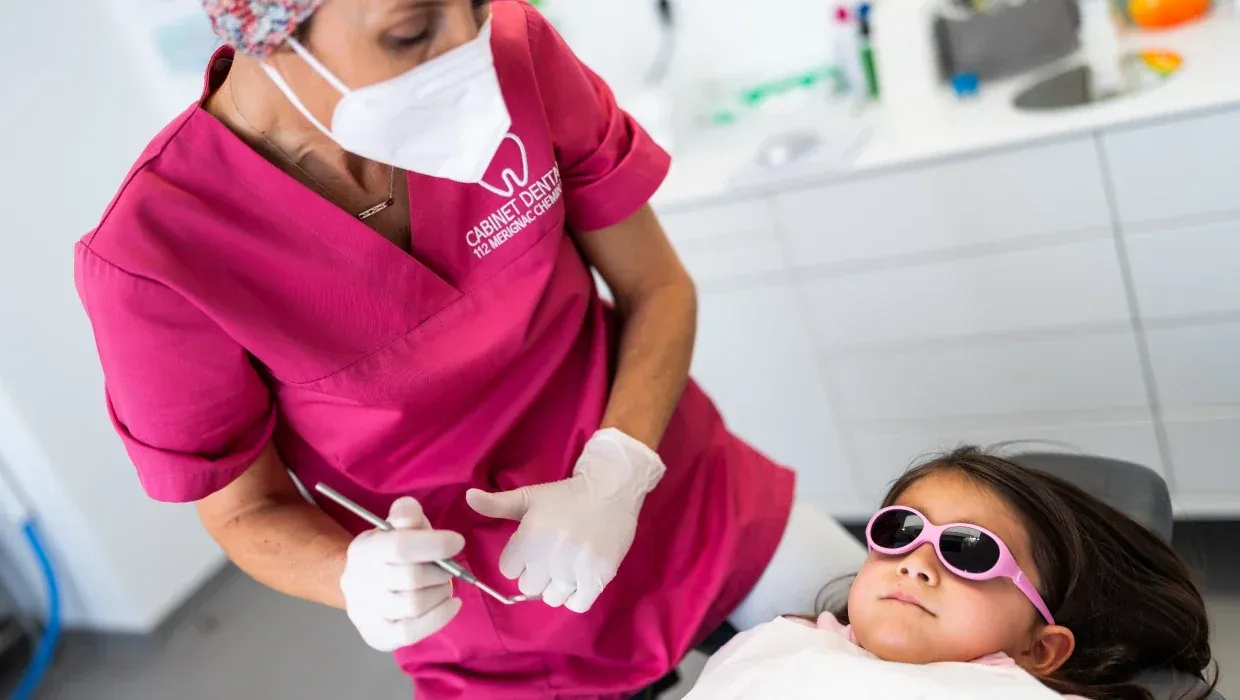
Reception can direct you to the appropriate dentist. An initial appointment allows us to assess your needs and provide a detailed estimate.
Read moreTooth decay · Preparing your child for their first dental visit · What happens at a first visit or check-up?…
Tooth decay
Children should develop good oral hygiene habits early to protect their teeth. Suitable brushing and a balanced diet are the best prevention. Detecting and treating decay in baby teeth is essential for children’s oral health.
Preparing your child for their first dental visit
Present the appointment positively as a normal way to look after their teeth, explaining that this dentist cares for children. Your attitude during visits is important in helping your child feel calm and confident. If one parent is afraid of the dentist, it may be better for the other parent to accompany them.
- Build your child’s confidence before the appointment using age-appropriate, positive words.
- Instead of “Don’t worry, don’t be afraid”, say “The dentist is kind and used to caring for children.”
- Instead of “The dentist won’t hurt you”, say “The dentist will be kind to you.”
- Instead of “needle” or “injection”, try “magic potion” or “putting the tooth to sleep”.
- Instead of “pulling out a tooth”, try “making the tooth dance until it comes out”.
- Instead of “scaling”, try “brushing” or “tickling the teeth”.
What happens at a first visit or check-up?
The visit helps build trust and includes a conversation, a clinical and radiographic examination and oral hygiene guidance. A preventive session may include plaque disclosure, cleaning or scaling and fluoride application. Afterwards, we explain the diagnosis, decay risk and specific hygiene and prevention advice.
How appointments and treatment work
Except in emergencies, no treatment is carried out at the first appointment or routine check-ups. Parents may accompany children up to age five into the treatment room. After that, parents are generally advised to wait in the waiting area.
Treatment is performed under a rubber dam, a sheet isolating the tooth or treatment area from saliva and bacteria. Teeth in the same area are treated together during the appointment, with definitive restorations.
Anaesthesia is almost painless with the Quicksleeper5 electronic “magic pen”. Its intraosseous technique also avoids the risk of post-operative biting. With MEOPA, the anaesthetic can become almost unnoticeable. Children’s treatment can be performed with conscious sedation using a 50/50 nitrous oxide and oxygen mixture. See the MEOPA article for details.
Who to see
Dentists providing children’s care.
The dentists associated with each treatment will be confirmed with the practice.

Children’s dentistry: let’s talk.
An initial appointment allows us to assess your needs, answer your questions and provide a detailed estimate.


